
MASSIMOASTROPHOTO
Il fascino e la meraviglia di fissare un cielo stellato limpido e scuro è uno spettacolo naturale
di una estrema bellezza.
In questo sito cerco di portare a conoscenza le bellezze degli oggetti celesti da me ripresi.
L’astrofotografia è la pratica di fotografare con una camera fotografica assieme ad un telescopio o un teleobiettivo la meraviglia, la bellezza e l'armonia degli oggetti celesti
come pianeti, nebulose o galassie.
Qui di seguito trovate le mie fotografie. Ora anche su
Benvenuti nel sito di Massimo Bollini. Now also on
The charm and wonder of staring at a clear and dark starry sky is a natural spectacle of extreme beauty. On this site i try to bring to light the beauties of the celestial objects that
i have photographed.
Astrophotography is the hobby to take photos of the wonder, the beauty and the harmony
of celestial objects such as planets, nebulae or galaxies with a photographic camera combined with a telescope or telephoto lens. This site collect my astroimages.
Welcome to Massimo Bollini website.
- LATEST IMAGES -
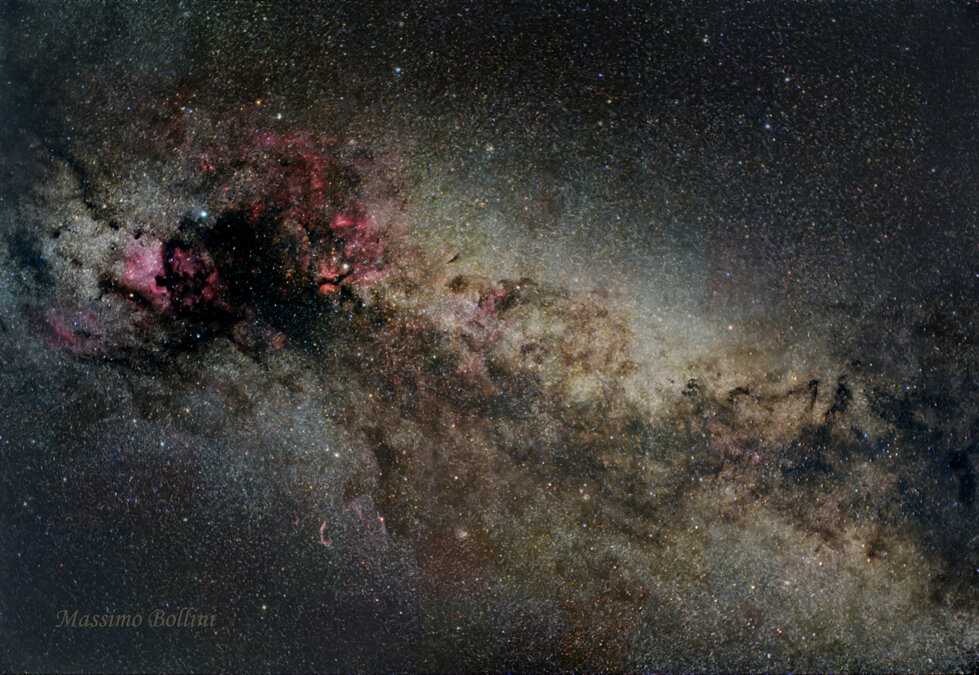
La Via Lattea nel Cigno
Nella mia zona della bassa pianura padana i mesi di Dicembre e Gennaio hanno avuto sempre il cielo umido e nuvoloso e non ho potuto fare nessuna fotografia, quindi pubblico una immagine effettuata lo scorso agosto da Coli sugli appennini piacentini.
La ripresa è per la costellazione del Cigno e la Via Lattea, oltre alla via lattea sono visibili alcune nebulose a emissione caratteristiche di questa zona come a sinistra è visibile la nebulosa NGC7000 Nord America, al centro la zona nebulosa attorno alla stella Sadr e in basso si intravedono le due nebulose Velo NGC6960 e NGC6992.
Ripresa con Canon 6D full spectrum e teleobiettivo 24-70mm. F2.8 posizionato a 50mm. 30 pose da 30 secondi ISO 3200.
The Milky Way in Cygnus
In my area of the lower Po Valley, the months of December and January have always had humid and cloudy skies, and I haven't been able to take any photographs, so I'm posting an image taken last August by Coli in the Piacenza Apennines. The shot is of the constellation Cygnus and the Milky Way. In addition to the Milky Way, some emission nebulae characteristic of this area are visible. On the left, the North America Nebula NGC7000 is visible, in the center, the nebula around the star Sadr, and at the bottom, the two Veil Nebulae NGC6960 and NGC6992 can be glimpsed. Shot with a full-spectrum Canon 6D and a 24-70mm telephoto lens. F2.8 set at 50mm. 30 exposures of 30 seconds each, ISO 3200.
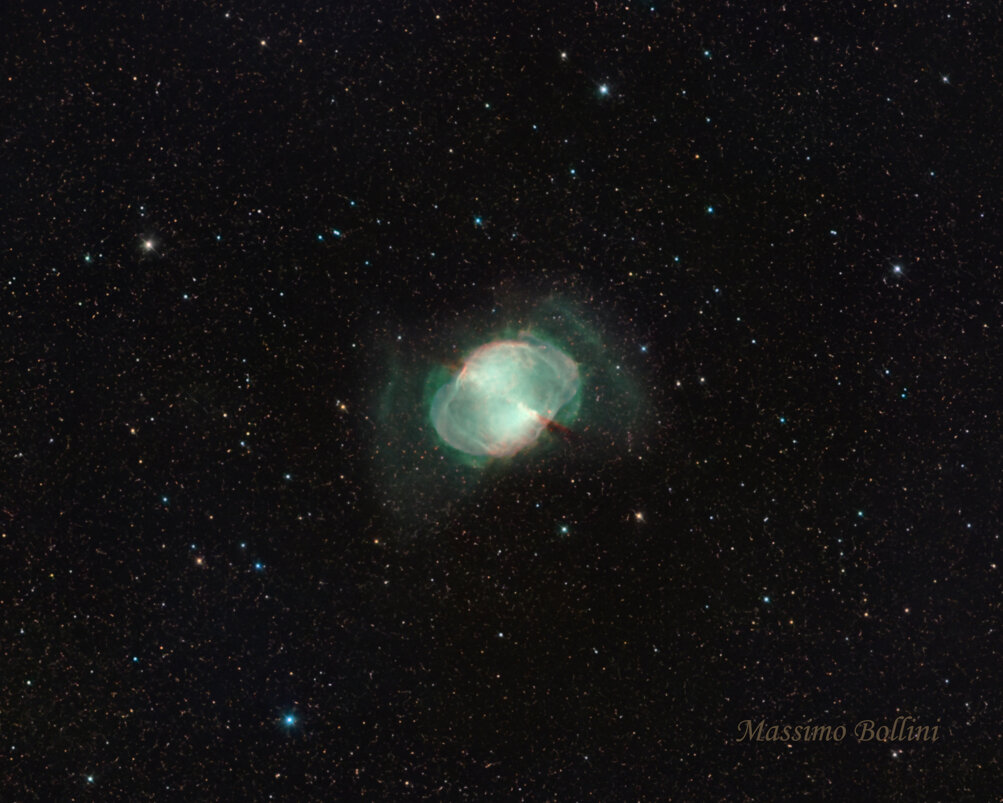
Nebulosa M27
Tra le molte e varie tipologie di nebulose presenti nella nostra galassia M27 conosciuta anche come Nebulosa Manubrio,
è una nebulosa planetaria nella costellazione della Volpetta,
Questa nebulosa è piuttosto facile da localizzare, trovandosi circa tre gradi a nord della stella γ Sagittae, di magnitudine 3,5; è visibile con facilità anche con un binocolo di media dimensione se la notte è molto buia in un luogo lontano da inquinamento luminoso.
Si tratta di una nebulosa a emissione che contiene idrogeno, ossigeno e altri elementi che un tempo facevano parte
della stella che è esplosa e formando questa nebulosa L’aspetto colorato spesso visto nelle fotografie deriva dalle diverse lunghezze d’onda della luce emesse da questi elementi quando vengono ionizzati. Ad esempio, l’ossigeno emette tipicamente una luce blu-verdastra, mentre l’idrogeno emette una luce rossastra.
M27 si trova ad una distanza di circa 1300 anni luce dalla terra
Ripresa effettuata da Cremona in Bortle 8 con un rifrattore Vixen SD103 F7.7. Camera QHY168C,
74 pose da 300 secondi con filtro Antlia RGB.
M27 Nebula
Among the many and varied types of nebulae present in our galaxy, M27, also known as the Dumbbell Nebula, is a planetary nebula in the constellation Vulpecula.
This nebula is quite easy to locate, located about three degrees north of the magnitude 3.5 star γ Sagittae; it is easily visible even with a medium size binoculars on a very dark night in a location away from light pollution.
It is an emission nebula containing hydrogen, oxygen, and other elements that were once part of the star that exploded to form this nebula. The colorful appearance often seen in photographs comes from the different wavelengths of light emitted by these elements when they are ionized. For example, oxygen typically emits a blue-greenish light, while hydrogen emits a reddish light.
M27 is located approximately 1,300 light-years from Earth.
Image taken by Cremona in Bortle 8 with a Vixen SD103 F7.7 refractor. QHY168C camera,
74 300-second exposures with an Antlia RGB filter.
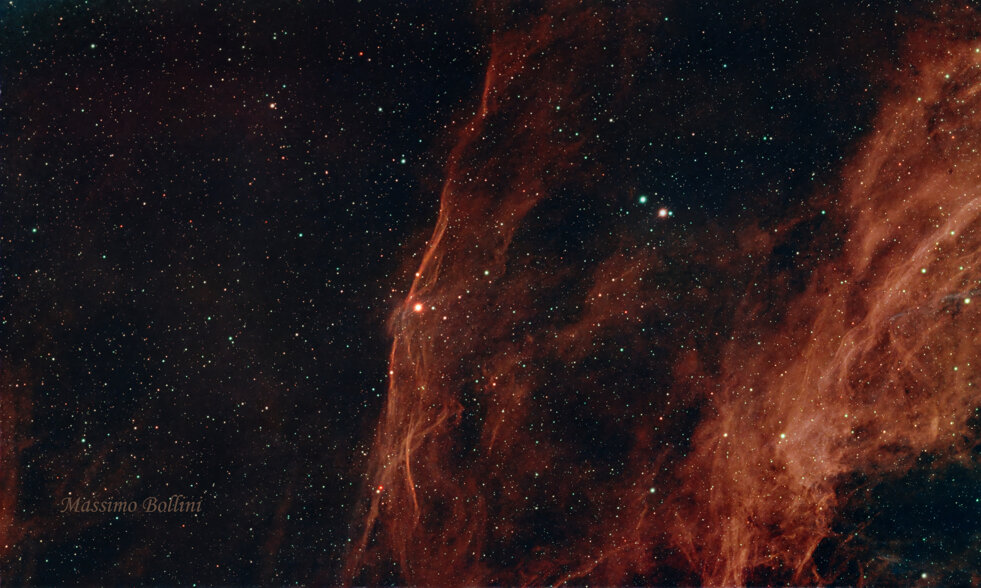
UN SOTTILE E DELICATO VELO IN CIELO
LBN 331, nota anche come Onde del Cigno, è una splendida nebulosa a emissione con delicati filamenti nebulosi situata nella costellazione del Cigno, vicino alla stella variabile 32 Cygni distante 1100 anni luce.
Sebbene possa assomigliare al resto di una supernova, come nel caso delle nebulose Velo NGC 6960 e NGC 6992 sempre nella costellazione del Cigno, in questo caso probabilmente i venti stellari sono responsabili della ionizzazione e dei filamenti di questa nebulosa. LBN331 fa parte di una ampia area di nebulose filamentose ionizzate in HII
Ripresa effettuata dai monti appennini piacentini con rifrattore AG70 F5, camera ASI071C, Filtro Antlia dual band Ha-OIII. 58 pose da 300 second e 30 da 120 secondii.
A THIN AND DELICATE VEIL IN THE SKY
LBN 331, also known as the Waves of Cygnus, is a splendid emission nebula with delicate filaments located in the constellation Cygnus, near the variable star 32 Cygni distant 1100 light years.
Although it may resemble a supernova remnant, as in the case of the Veil Nebulae NGC 6960 and NGC 6992, also in the constellation Cygnus, in this case stellar winds are likely responsible for the ionization and filaments of this nebula. LBN 331 is part of a large area of ionized filamentary nebulae in HII.
Image taken from the Piacenza Apennine Mountains with an AG70 F5 refractor, ASI071C camera, and Antlia dual-band Ha-OIII filter. 58 for 300-second and 30 for 120-second exposures.
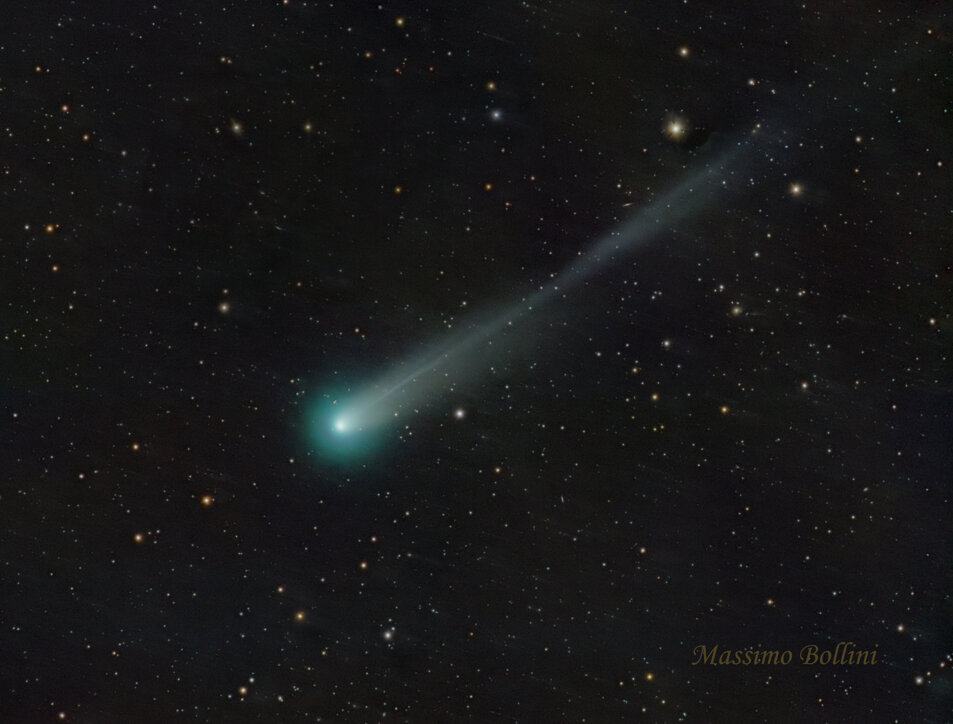
Cometa C/2025 A6 Lemmon
In questi mesi passano vicino alla terra alcune comete abbastanza luminose che possono essere osservate sotto cieli non inquinati anche con piccoli strumenti.
La cometa C/2025 A6 Lemmon è una di queste.
Ho effettuato la ripresa il 29 Settembre alle ore 4.00 ora locale da Gorzegno nelle Langhe piemontesi.
Sono 42 pose da 90 secondi con un rifrattore Vixen SD103 F6 e camera QHY168C.
La sua chioma appare compatta e di colore verdastro mentre la coda è ben evidente anche se soggetta
a variare secondo l’attività cometaria.
Al momento della mia ripresa la cometa era nella costellazione della Lince, vicino all’Orsa Maggiore,
La sua luminosità era stimata di magnitudine 7.0, ma è previsto che nei prossimi giorni di Ottobre e Novembre aumenti la sua luminosità diventando ancora più visibile.
Comet C/2025 A6 Lemmon
In recent months, some comets have been passing close to Earth, bright enough to be observed under unpolluted skies even with small instruments.
Comet C/2025 A6 Lemmon is one of these.
I captured it on September 29th at 4:00 a.m. local time from Gorzegno in the Langhe region of Piedmont.
I took 42 for 90-second exposures with a Vixen SD103 F6 refractor and a camera QHY168C.
Its coma appears compact and greenish in color, while its tail is clearly visible, although it is subject
to variation depending on cometary activity.
At the time of my photograph, the comet was in the constellation Lynx, near Ursa Major.
Its brightness was estimated at magnitude 7.0, but it is expected to brighten over the next few days in October and November, becoming even more visible.